Maxwell Alexandre: Black Painter, White Figuration
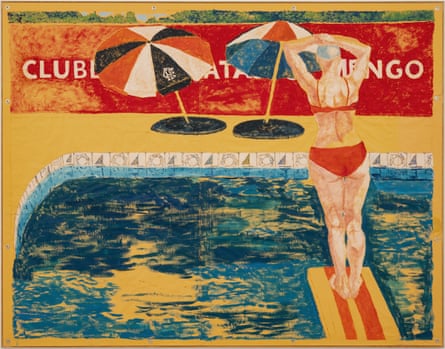
A vast red concrete wall splits Maxwell Alexandre's work in two. It's the wall of the Flamengo sport club in the painter's native Rio de Janeiro, a towering crimson monolith of division, literally separating us and them, rich and poor, black and white.
Alexandre joined the upmarket club in the early 2020s. He'd walked past its red walls countless times as a kid – the club is on the edge of the favela he's from, the biggest in Brazil. What he found inside was serenity, sunbathing, prosperity, and whiteness. He'd spent his early career painting the black figures of his favela, but now he was surrounded by pasty bodies with rippling pink skin.
With success in his career, he'd bought access to this new world, and knew he couldn't paint the same black figures he'd made his name with. So this is the result, dozens of paintings of lush tropical trees and white bodies in repose, lounging, chatting, playing by the pool within the confines of that red well, all part of his new approach to what he calls "white figuration".
The red walls dominate the works in the first space as a figure stands on a diving board and palm fronds wave in the distance. The second room is covered floor to ceiling in paintings on brown paper of the club's members, some shown next to figures from art history. Boys stand in the sun, men splash in the water, girls talk and women sunbathe. It's idyllic, hazy, almost nostalgic painting.
But it's full of emotional complexity. The work is a rejection of the expectations placed on black artists to make black work, to churn out paintings of black figures to sell to white audiences and collectors. It's Alexandre refusing to play the game. But there's also an introspective exploration of what happens when your life changes, when you stop being young and poor and desperate and become something different. This doesn't feel like Alexandre mocking white flabby bodies, it feels like him trying to make sense of a divided city, an art history that doesn't represent him, and a world that expects you to be something you no longer are. It all looks like heaven, but even heaven is a complicated place.
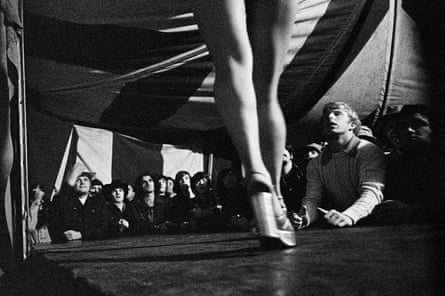
The exhaustion in Susan Meiselas's photos is so palpable it's almost draining. She spent three years in the mid-70s following a group of striptease performers as they toured the endless American sprawl, slowly gaining their trust, capturing them at their most intimate, unguarded and knackered.
She photographs them from backstage. Night after night the women dance seductively for wide-eyed, drooling, dumbstruck men – you see them gawping from between the dancers' legs, anonymous pervs desperate for an eyeful.
And then the dancers crash from the effort of it all. They smoke distractedly, lounge on sofas or crumple into bed. This is the end result of physical labour: total collapse, utter exhaustion.
In lots of the photos dancers peek through the curtain back on to the stage, waiting their turn, watching things turn ugly for the poor performer on stage.
The more posed images don't give the viewer much, but when Meiselas captures the dancers unaware, lost in the moment, they're pretty special. These are stories of exploitation and entertainment, work and exhaustion, leaving behind nothing but physical, emotional depletion.
Huxley Parlour Photographs, London, until 21 November
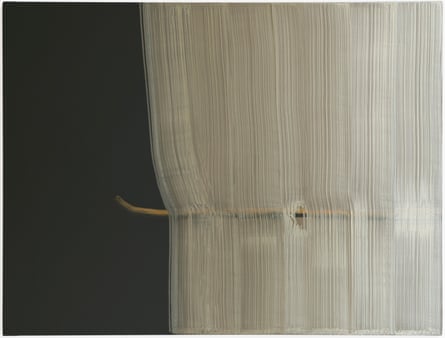
Hyun-Sook Song says so much with so little. With just a handful of brushstrokes, the Hamburg-based Korean painter opens up a whole world: written into every mark are her memories of life in deeply rural, mid-century South Korea, her shock at the monstrous urbanity of modern Germany, her desperate need to find sanctuary in painting.
The minimalism of the whole thing is made obvious by the titles. The works are called things like 11 Brushstrokes or 6 Brushstrokes over 1 Brushstroke because that's all they are, but they're more complex than that implies.
She lays each canvas flat first, and paints every mark in a long, sweeping, full-body motion, physically trying to communicate her ideas into the work. The paintings are all on dark green or black backgrounds, each swooping brushstroke creating a gossamer white veil across the darkness. Cutting across almost all of them is a brown line, a stick that seems to almost lift the impossibly thin curtains. The white marks reference the raw silks collected in her youth, the brown marks nod to boundary posts that delineated her childhood landscapes. There are all these ideas of separation and division, of veils being lifted, of quiet and peace. They're almost unbearably fragile paintings, but all the more beautiful and meditative for it.
Sprüth Magers, London, until 23 January 2027
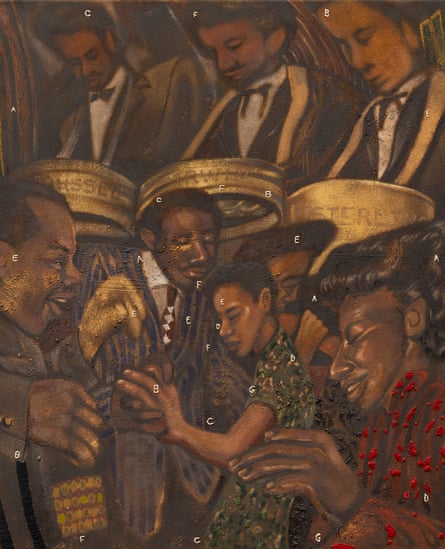
Way before London's Carnaby Street was one the capital's main tourist taps, it was a proper cultural hub, a place for fashion and music to flourish. And No 50 Carnaby Street was home to six different music venues between the 1930s and 80s which helped totally change the cultural landscape of the country. Whether it was the Sunset Club in the 50s or Columbo's in the 70s, this address is where activism met music, where jazz gave way to steel bands and sound systems, where black met white.
This tiny show in Sadie Coles' downstairs project space by Studio/Chapple gallery celebrates 50 Carnaby Street just around the corner from the original address. The walls are painted deep brown, handmade speakers by Maya Ramnarine play out the sounds of old jazz and ska records, paintings show dancers moving in tightly crowded spaces, performers playing to packed rooms. I don't love all the works here, but the idea is good, and the two paintings by Georgia Semple and Amida Deen are great. Semple's is a dark, atmospheric vision of the Russ Henderson Steel Band, Britain's first steel pan ensemble, playing to a crowd of joyful figures slowly swaying to the music. Deen's work travels to the 1970s, with people pressing themselves together in a room of fiery red and heat-soaked orange as dub pours out of the speakers.
The show is a tiny love letter to music history, clubbing and dancing. You can almost smell the sweat.