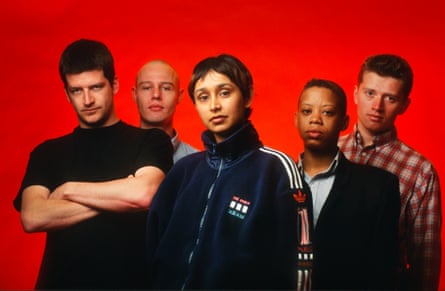
n 1994, Oasis toured the US for the first time, and a legend quickly emerged: these were Britain's latest rock'n'roll renegades, who went berserk on crystal meth before a Los Angeles gig and almost split up afterwards. But Sonya Madan remembers it differently. Her band Echobelly were also touring the US that year, and the two groups hung out backstage at each other's gigs.
"I'm gonna blow a myth!" she hoots. "For me, half the stuff about Oasis was made up by their press people. The people around them were partying; everyone was, including us, but it wasn't much. Liam was such a sweetheart, I used to go drinking with Noel, we were all mates."
In fact, according to Madan and bandmate Glenn Johansson, Echobelly – whose 1995 album On reached No 4 in the UK album charts and made them one of the Britpop scene's big commercial prospects – were the ones raising hell. "I wasn't," Madan says. "I just can't dabble [in drugs], personally." A member of their touring party once took crystal meth in California and spent 12 hours overnight pacing up and down the tour bus, Madan says, "frothing at the mouth", while the then-dabbling Johansson agrees it's "horrible stuff; it lasts for-fucking-ever". Another time, in Chicago, an uninvited stranger – a very tall man with albinism, long white hair, in a black leather coat and black Stetson – walked on to the tour bus. Madan cackles: "And he said: 'Hi, my name is Satan, I'm your local drug dealer, anything you want?'"
Johansson says: "That night there was enough cocaine around to put us away for 10 years. Ridiculous days. Good fun, though."
I note how this kind of behaviour just isn't seen as cool any more. "Very true," says Johansson, who has had no interest in drugs for the past 20 years. "And no one drinks, hardly."
Madan adds: "But whether it was cool or not, it was just everywhere. The BBC, ITV, Houses of Parliament …"
Johansson: "I don't think gone away, to be perfectly honest!"
The pair met 36 years ago, when Madan, after seeing Johansson's previous band play in a London venue, threw a fag packet his way with her number on. After briefly dating, they became best friends, musical collaborators and housemates for the past 30-odd years.
The pair are in their living room, a large, airy space in the spotless London garden flat they share. Madan sits on the sofa, leaning on a Beatles cushion, with Johansson sitting on the wooden floor. Both are warm and thoughtful, with a mischievous edge, as they talk about their new album Eye-magi-nation for the first time: an initially flustered Madan cites "spiritual books" as an inspiration, "which sounds wanky …"
Where Echobelly's 90s sound was youthful, anthemic euphoria, Eye-magi-nation – their first album in nearly a decade, released next spring – glimmers with grownup sophistication. It is a cinematic soundscape spanning portentous post-punk, beautiful jangle-pop, country-tinged melodies and hypnotic east-Asian-tinged scales; the mesmerising Firefly, an older song reworked for a friend's bridal walk, recalls Radiohead's Pyramid Song.
Madan's lyrics contemplate planetary destruction, human psychology and spirituality; the album title references "the inner, knowing eye, the Magi within us". Madan, who is of Indian heritage, always rejected organised religion, once describing it as "like nylon, man-made", and she rebelled against her parents' strict rules around career expectations and arranged marriage. Today, she embraces and recommends meditation. "The planet is an increasingly mad, vexatious place," she says. "There's a lot of depression, anxiety. I think people need to go within."
The album's lead single Happiness Can Charge Its Own Price is an optimistic reflection on following your own path, and the pair – now the only official Echobelly members – are happily self-releasing the album after a two-year label dispute. Without a label, Madan smiles, they were creatively untethered, and found "utter joy in being totally free", even if this meant a lack of professional amenities. "I have to sing in the bathroom, my rehearsal room," she says. "I wrote this album sitting in the wardrobe so I wouldn't disturb the neighbours."
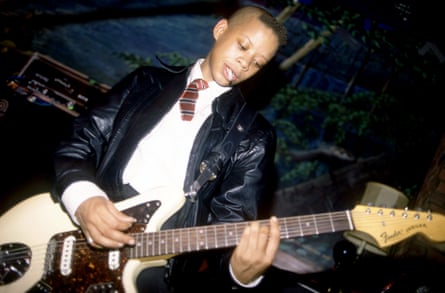
Echobelly were always outsiders: multicultural, cosmopolitan Londoners comprising the tiny Madan (who was born in Delhi and moved to London when she was two), the lofty Swedish musical impresario (Johansson, a former economics student in Gothenburg, who moved to London in about 1990) and a Black, queer guitarist (original member Debbie Smith). But they were drawn up into Britpop's tornado, nonetheless, and became close to the scene's biggest acts.
They were pals with Oasis, though Noel Gallagher "did have an edge," Madan says. "He'd pick me up" – she mimes being physically held aloft – "but then would say something bad about us in an interview. But overall, all the Manchester bands – Shaun, Bez, Morrissey – were really nice, funny, supportive. And Blur. I had no experience before Echobelly, my family were all academics, and Damon [Albarn] took me under his wing in the beginning. Because I was a bit lost and naive."
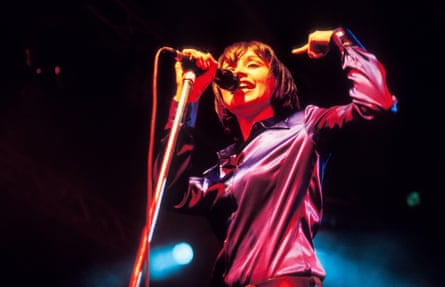
Their lives were changed by On, their second album, which featured the exuberantly catchy Great Things and King of the Kerb: fans soon numbered Madonna, Morrissey and REM, and Echobelly were invited to support the latter on 1995's Monster tour.
Madan, seen as an underrepresented role model, inspired feverish devotion. In Canada, she saw "a whole group of Sonya clones, Asian girls, with the same haircut", and met a gay Asian boy backstage who openly wept: "You don't know what you mean: one of us on stage!" In Prague, a fan stormed the stage, clutched Madan's ankles, made "I'm not worthy" gestures and was dragged away by local soldiers with guns (that night's security), Madan yelling at her manager: "Make sure they don't beat him up!"
"We had," smiles Johansson, "aof weirdos."
In the decades since, Madan and Johansson have remained musical soulmates despite a turbulent timeline. Echobelly went on hiatus in 1997 as Madan weathered a life-threatening thyroid condition, and the band endured lineup changes, being dropped by Sony and their accountant defrauding them of £100,000. Back together in 2001, they split again in 2004, before an acoustic reunion in 2009 and a full-band comeback in 2015.
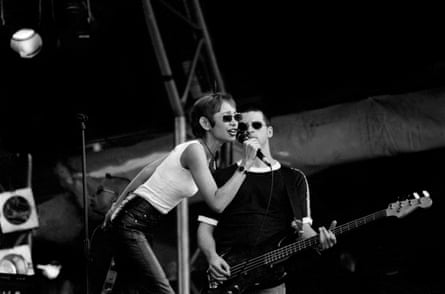
"We've had our fair share" of strife, says Madan. "And if it did break us, we put [ourselves] back together again. Nothing stays the same and it shouldn't. Besides, we're not qualified for anything else!" By 2025, their 30th-anniversary On tour was attracting an influx of gen Z fans. "Such a pleasure, especially hearing young girls saying Great Things is the soundtrack to their life," notes Madan, saying those fans have "the same positivity that inspired the writing, when you're young, dumb and full of …" An uproarious laugh. "Imagination!"
In recent years, female Britpop artists such Lush's Miki Berenyi and Sleeper's Louise Wener have reconfigured the celebrated 90s as a ruinous time for women, in bands and in general, citing an insidious culture of sexism and laddism, including from male stars. Madan disagrees, suspecting that today's media has "encouraged" an unbalanced, negative consensus. "The truth is not always what people want to write about, because it has to be ," she asserts. "I found the male artists were really nice, kind, non-sexist."
Madan says the mostly male music journalists of the era pitted the women in bands against each other and "pulled you up and put you down, a very British thing". She experienced, however, "much more trouble from the women" in Britpop, with intense rivalry between female-fronted bands: "It was very cliquey; there wasn't much camaraderie."
Yet Madan's feminism was never in question: her early lyrics challenged gender inequality, power imbalance and patriarchal oppression. For his part, Johansson was disturbed by the UK's attitude to gender when he arrived. "Women have a prominent, more equal role in Sweden," he says. "Even in the workplace, you didn't have the secretary who makes tea for everyone and gets slapped on the behind. When I first came here, I found it weird: asking [a woman] for a coffee? Make your own fucking coffee!"
Next year, after Eye-magi-nation's release, Echobelly will tour again. For Madan, the ambition is to keep going. "You do it because you to do it," she says. "It you. You might think being a 'rock star' is this and that, but the reality is, it's a bottomless pit of anxiety. Insecurity. There's no pension plan! But life would be grey without it. And we're freer now than we ever were. We're still able to make music, we still have a following, we're still able to do it for the right reasons."
Johansson adds: "I think a lot of this is because we came out of a scene, Britpop, which has had longevity, the records still played today. I find it hard to see bands of today being played in 30 years' time."
Their band, then, will simply carry on, even without the stratospheric riches of their former US touring pals. Will they be able to sustain themselves financially?
"We live on beans on toast," says Madan. "And a bottle of wine. I'm not joking! We don't go out much." But for Echobelly: "These are good times, times. Because it's full of potential. It's hope that keeps people happy."