t was chilling for me, as a survivor of the 1973 coup that installed a bloody 17-year dictatorship in Chile, to watch Wild Horse Nine at a theatre in Santiago, a viewing haunted by those who had been killed and disappeared during the reign of General Augusto Pinochet.
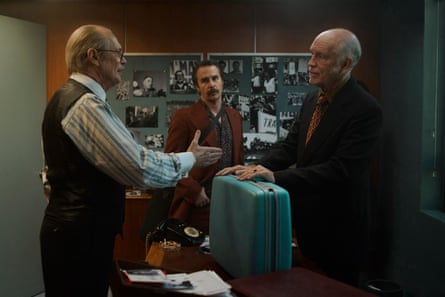
Though Martin McDonagh's film is set shortly before the military takeover, it disturbingly foretells the atrocities that are to come, a terrifying future that is known to the protagonists, Chris and Lee, because, as CIA agents, they have been instrumental in the conspiracy to destroy the peaceful revolution of democratically elected president Salvador Allende.
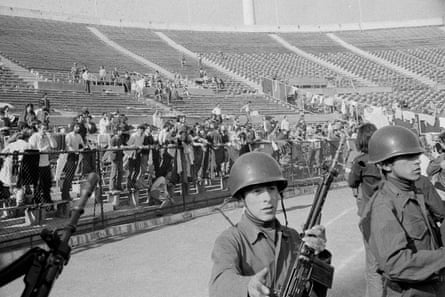
Chris (John Malkovich, in a stunning performance) is dying of cancer and saturated with regrets about his interventions in other lands that were once democratic. On a trip to Easter Island where he has gone to spend his last days, he meets Mónica (Mariana di Girolamo), an idealistic leftwing Chilean student. Beguiled by her ("She is life. And I am leaving it."), he gradually reveals not only his own clandestine identity and the date of the coup, 11 September, but the fate that awaits Allendistas like her who will be rounded up, taken to a soccer stadium to be tortured and, some of them, executed.
Besides suggesting that she flee the country, he urges Mónica, at some point, that if they do come for her, "don't ever let them get you in a car. Fight and die in the street, but don't let them ever get you in a car." Chris is not only predicting what happened to countless Chilean citizens, dragged into cars on their way to becoming "", but also what almost befalls Mónica when the men sent to Easter Island to silence her due to the secrets she is now privy to, try to drag her to a car and eliminate her.
She escapes that kidnapping as the film ends, but her counterparts in the historic future will not be so lucky. Nor, I fear, will she. It is easy to anticipate that she may well, in the appalling times to come, turn out to be one of the innumerable victims of the dictatorship.
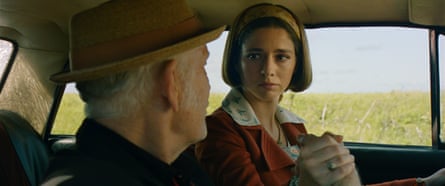
My dark forebodings about Mónica may be due to the circumstance that I have been bearing witness for over 50 years to the assaults on female dissidents and rebels, forcing myself – not sure if it is a curse or a blessing – to write about them obsessively in plays such as Death and the Maiden and my story collection, What She Saw. But my apprehensions about what lies ahead for her were also tied to the space where I made her filmic acquaintance.
The ghosts and memories of women who suffered grievously during the dictatorship are everywhere in the very city and, indeed, neighbourhood, where the movie was being projected. I saw it at the Cinépolis La Reina, which is at the intersection of Avenida Ossa and Simón Bolívar. Twenty blocks towards the mountains, there stands an apparently innocuous house at Simón Bolívar 8630, one that I frequently pass at dawn during my morning walks. It once served as the Cuartel Bolívar, a torture center set up by Pinochet's secret police, where several friends of mine were tormented and killed, though I never met Marta Ugarte, the most notorious of those who suffered there. Sadly notorious, because her body washed up on a beach on September 12, 1976, tied to a metal rail. The regime tried to cover up the homicide, but it would emerge that she had been strangled or mortally injected, probably with cyanide, and then cast into the Pacific Ocean from a plane, one the infamous "" employed to get rid of prisoners, dead and alive.
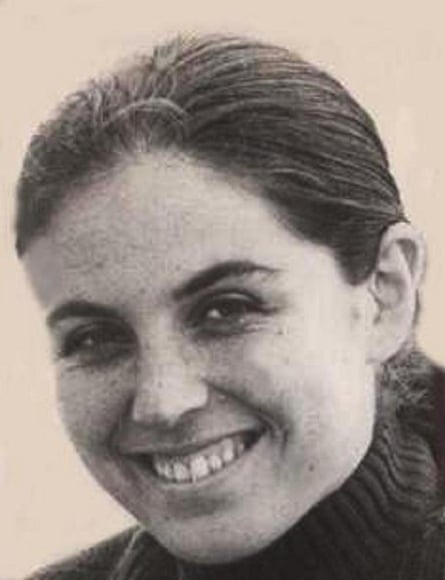
She, at least, had been offered a burial. But Diana Arón, very much on my mind as I watched the film, is still missing. One of my journalism students who subsequently worked with me at Onda magazine in the State Publishing House, she was arrested on Avenida Ossa, not far from where the story of the fictional Mónica, also a student, and about Diana's age, is now being told. After being shot and hustled into a car (shades of Chris's warning to Monica), Diana – seven months pregnant – was taken to Villa Grimaldi, another detention centre, some 30 blocks north-east of the cinema, also in my neighbourhood. It was at Villa Grimaldi, at the end of 1974, that my friend, Carmen Bueno, a young actor with a future as luminous back then as Mariana di Girolamo's today, was serially raped and murdered – and is still a .
What is sobering is that if I had chosen to see Wild Horse Nine in another location in Santiago I could list other names and other torture houses, Londres 38 in the centre of the city or José Domingo Canas 1367 in Ñuñoa (two blocks from the national soccer stadium) or … on and on I could go. With up to 1,168 detention centres, all the land is contaminated by an agony that has not been assuaged by the decades that have passed, the dead who continue to cry out for memory and justice.
But was my commemorative reaction an exception, shaped by an awareness that, no matter how much perverse time has transpired, the space where that savagery was perpetrated still remains close by, howling silently its message of sorrow? How much will the tragic figure of a devastated Mónica help to restore her real life counterparts to the public's attention? Had not a majority, after all, elected, less than a year ago, José Antonio Kast as their president with 58% of the vote, a far-right admirer of Pinochet (and Trump!), a politician who thought the criminals currently in prison for egregious violations of human rights (like the murders of Marta Ugarte or Carmen Bueno) should be pardoned?
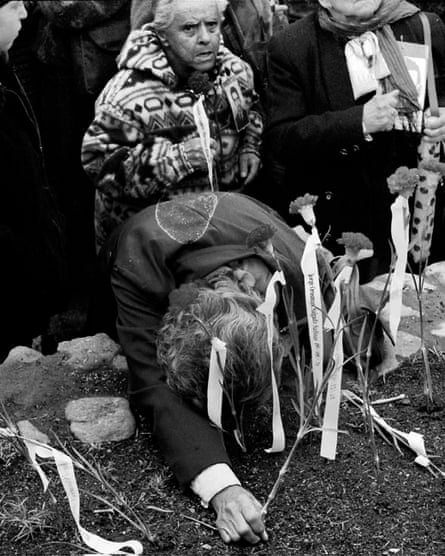
Curious to go beyond my own particular immersion in the film, I approached some young couples chatting animatedly in the lobby after the film was over. I selected them because the three women in the group were about the age of Mónica in the film, probably born around 1990, as democracy was being recovered in Chile, with no familiarity with the years of dictatorship and certainly none with the coup itself. I assumed they would be mindful of the dismal aftereffects of the coup and sympathetic to Mónica and her dreams, given that they had chosen to view a film which portrayed Allende as a decent leader ousted by a cabal of CIA agents allied to the military.
Rather than that subject, they happened to be discussing whether Mariana di Girolamo could win an Oscar and cement her international stardom.
Apologising for the interruption, I wondered if they had thought about what had happened to Mónica's character during the Pinochet years. After a prolonged silence, one of young women spoke up, shuddering: trying to come up with an answer. "Nothing good." And another added: "Yes, those were terrible times. In my own family …" But her voice trailed off. It was not an ordeal she was eager to dwell on. And certainly not with a stranger.
When I nevertheless persisted and asked if they had heard about the nearby Cuartel Simón Bolívar, pointing at the street that bordered the theatre, they expressed puzzlement, and also shook their heads when I alluded to Marta Ugarte, Diana Arón, Carmen Bueno. Perhaps it is unfair to take such a lamentably small and merely anecdotal sample of young people and draw conclusions from their lack of specific knowledge about such supposedly distant misfortunes and names, but they seemed to be part of a general tendency in Chilean consciousness, a sort of soft amnesia that seems to have tainted the country.
I can only hope that Wild Horse Nine and the luminous figure of Mónica can join the multiple ongoing efforts in Chile, the determination of many patriots who refuse to forget the coup and its aftermath, demanding that the nation face a disturbing past that needs to be reckoned with. Even more so at a time when the terror of that past is being actively denied by complicitous people in power.
The troubling events of Chile are, of course, not the only past that is being evoked in the film. Chris, as he faces death and the recurrent question of whether he will be admitted to heaven after his misdeeds, reminisces about the different lands where he intervened to destroy democracy, referring to Guatemala (twice), Indonesia and the Congo, all lands that suffered massacres of countless innocent people and immeasurable havoc after American meddling. Indeed, it is implied that his misgivings about these interventions (plus his involvement in the Kennedy assassination in Dallas, after which "the whole country went to shit") may be eating away at him with as much ferocity as his illness, part of the same cancerous onslaught.
As a citizen of the US, as well as of my Chilean homeland, I was particularly attuned to this aspect of the film, how Chris – as an avatar of the US just as Mónica is of Chile – is dealing with American violence at home and abroad and how it affects the country of his birth and the future he will not be around to register. As I watched Wild Horse Nine, though it is not mentioned by Chris, Iran was the country I kept considering. It was there that the CIA, in 1953, helped the British depose Mossadegh, the progressive president, and install the despotic Shah regime that would eventually lead to the takeover by the ayatollahs and their Islamic dictatorship and, now, in 2026, to Trump's catastrophic war that has been partly responsible for the unravelling of his power.
At some point, when it is revealed that Chris is suffering from the same cancer that dispatched his mother, Chris's brother says: "What goes around, comes around." It is a message that resonates beyond the illness that is devouring the CIA agent, an elusive but parallel warning to Americans that the sins committed in their name, near and far away, have consequences for decades to come.
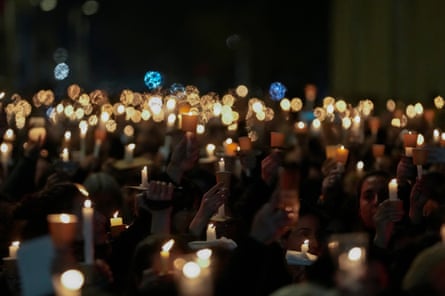
As I walked away from the cinema, my heart broke for Mónica and for her broken country and for the foreign nation that did not care if her dreams of peace and justice were thwarted and twisted and demolished. Hoping, also, that enough hearts be broken in Chile and the US so that such tragedies will never again be repeated.