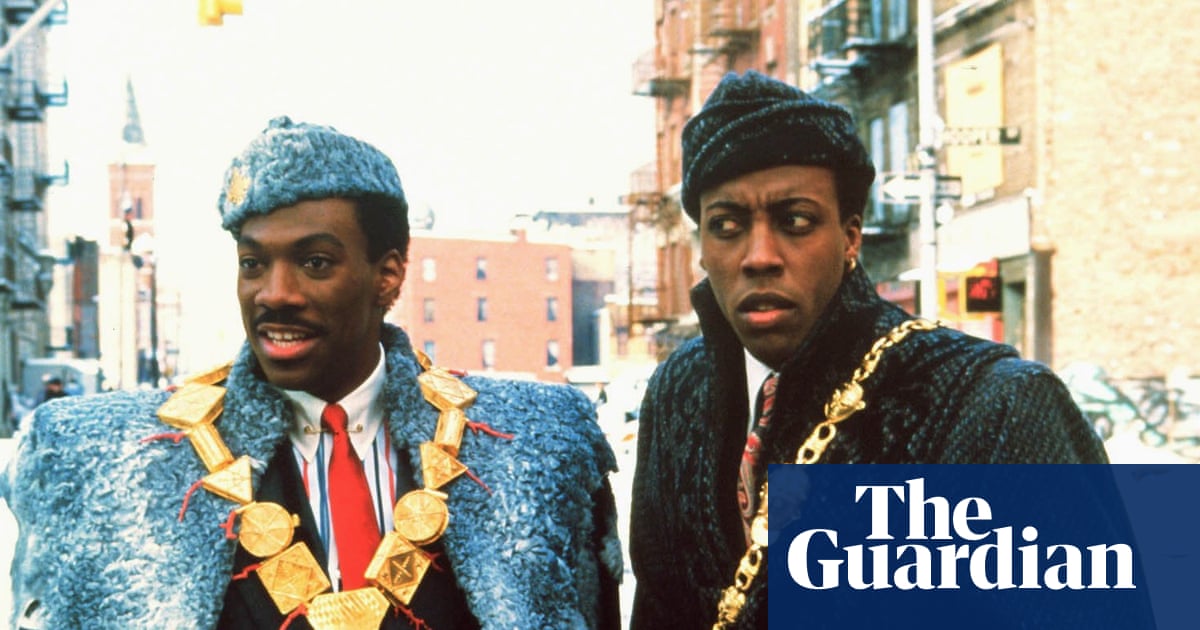
"Good morning, my neighbors!" A young Eddie Murphy shouts from the balcony of a shady apartment building. In the bustling Queens neighborhood, he sticks out like a sore thumb with his foreign accent, tailored blazing jacket and red tie. "Hey, fuck you!" A voice yells from below and Murphy repeats the phrase, believing that it's a greeting rather than an insult. It's one of the standout scenes from the film Coming to America, because it's so absurd but effective in that there is a cultural clash going on here.
In Coming to America, Prince Akeem, played by Eddie Murphy, is the sole heir to the throne of Zamunda, a fictitious African country. Instead of having an arranged marriage, Prince Akeem exercises his autonomy and intends to find his own bride somewhere far away from the continent, much to his parents' chagrin. With the coin-flip and a roll of the personal globe, Akeem and his sidekick Semmi go to America but more specifically Queens because where else would be more fitting to find his bride? While trying to assimilate to the fast pace of New York living, he pursues Lisa, the heiress to a different kind of throne – that of a fast-food business called McDowell's. The problem is, she's already engaged to another. Akeem hides his identity as a royal prince and works at her father's fast-food restaurant to get closer to her. Will Akeem and Lisa fall in love as he cosplays being working class. Will Lisa leave her rich but arrogant fiance? Will their families accept their Lisa and Akeem if they do decide to marry? Spoiler alert: there's a happy ending. The plot progression is simple but the character development is full of heart and candor.
Watching Coming to America reminds me of home, but especially my mother. I'm not sure when exactly I saw the film for the first time. However, there's not a moment in my childhood where Coming to America was not present. Every time it was on TV, my mother and I would watch it. I'd sit on her ottoman in her bedroom or curl up on the living room couch to cackle at scenes that I'd already watched dozens of times. Like many Black households, Eddie Murphy was a regular presence through our television screens but I didn't grow up on Trading Places, Beverly Hills Cop or even Boomerang. It was Coming to America that was in heavy rotation. Coming to America was my entry into the romcom genre.
Don't get me wrong: I'm used to romantic stories. I'm a 90s baby so I grew up on Disney and Mary Kate and Ashley movies and dreamed of the day when it would be my turn to be transformed through falling in love. But the difference between those types of cinema and Coming to America is that I could actually see myself in the latter. The cast reads like a who's who of Black Hollywood – Arsenio Hall, James Earl Jones, Madge Sinclair, Garcelle Beauvais and John Amos with early appearances from Samuel L Jackson and Cuba Gooding Jr. Its actors were from the United States, Jamaica and Haiti. Coming to America isn't just a love story between two individuals, but of different peoples and cultures within the diaspora. I didn't have to shoehorn myself into the silver screen; I was already there. The fairytale elements are also present – royalty, love and its obstacles, marriage, an imaginative, distant land. Yet these components are scripted on to a recognizable place. There are the rats scurrying across dirty New York apartment floors, trash on the sidewalks, banter in the barbershops. As a product of the 80s, the women of the film have big hair and wear vibrant-colored clothing, the men have Jheri curls or low afros, and the choreography and score are from Paula Abdul and Nile Rodgers, respectively.
Though Coming to America received mixed reviews upon its release, it now has a cult following of which I am a proud member. The film's cultural impact cannot be overstated – Busta Rhymes, Nas, Kanye West and the Barbershop franchise owe a part of their art to Murphy playing multiple characters, the cinematography, or the wisecracks ricocheting from one person to the next throughout the story. But as for me, Coming to America remains a cornerstone of my nostalgia and a current reminder of how family is the one you were born into as well as the one you make. As someone who has lived and fallen in love in New York, I can attest to the awkwardness and the splendor of what this city can do to a prince or … a commoner like me.
-
Coming to America is available to rent digitally in the US, UK and Australia