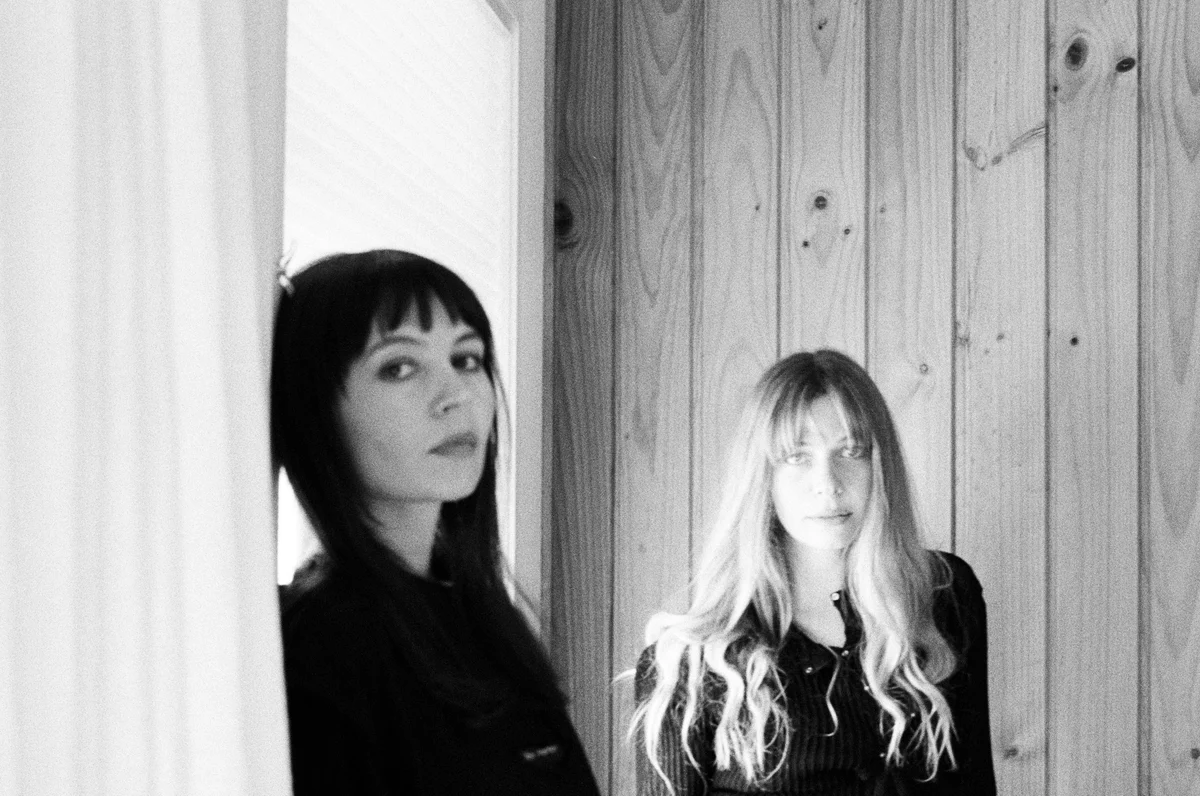
“Romance is dead / I dug its grave,” they announce to open first single “Innocence Lost”, setting the table of a record charting the push and pull of romantic relationships, coaxing us into their mind-melded creative flow with sunlit guitar lines and rounded, gauzy vocal harmonies. In their search to assign sound to the break and rebirth of the heart, the music is ephemeral, but contained, as if these songs could only breathe and survive in the greenery of their makers’ solitude. They exist in 1966 and 1986 and 2026 – of no time and place and of any time and place. A “Be My Baby” backbeat will render one song a sepia-toned postcard taped flush in a scrapbook, but the lyrics will read like a cult’s ritual chant, willing love to the voices in our headphones. If these songs did, in fact, come together so eerily fast in the duo’s hands, it might only have been possible through unspoken alchemy, blending long-banked memories of pop history with the fresh tear of romance found or lost, alive or buried. The heart can sing without consulting the head first, as the sisters would know.
If anything, the approach to writing and recording not only felt steeped in music’s past, but in Purple Pilgrims’ personal past – as their formation, too, came both out of necessity and by accident. “Valentine was studying folk music and singing, and I went to art school,” Clementine remembers, “and we very naturally merged those two disciplines. We didn’t like to think too much about it. We were really young and it just happened. I was working at a gallery, and there was a support act needed for this experimental show, and someone suggested, ‘Why don’t you and your sister [perform]?’ Because we’d been messing around at home.” Their desire to create “something new,” in her words, was largely inspired by the decades-long lineage of Christchurch’s alternative forbearers, pulling from the likes of The Dead C and Roy Montgomery, the latter of whom has since played with Purple Pilgrims. In curbing their folkier impulses, which Valentine says are still “ingrained in some kind of past-life way,” the pair were able to reveal something discordant that their union stirred within them, unconsciously pulling threads of desire in the way only telekinetic sisters could.
In these early performances and writing sessions, Clementine recalls, “the intention was more loose, and we were working through ideas and feelings and as they came, instead of forcing any sort of outcome. Sometimes, we didn’t necessarily think about anyone hearing them.” Years later, having released several full-length efforts on Flying Nun and fully ingratiating themselves into their home country’s experimental lineage, it took returning to the untamed belly of the land to create that unconscious friction again. The result is less noisy or challenging than their earlier releases, but does sound as if it could only pour out of a blood-bound connection, where stopping to conceptualise or tinker might thin the creative flow.