Snaking stairways lead to lengthy hallways lined with the near-identical portraits of the members of this Masonic organisation – legions of old men wearing fezzes – alongside kitsch oil paintings of puppies with extraordinarily wide, sad eyes and posters making cryptic inquiries such as, ‘Does your best friend know from whence you came?’
There are two dancefloors, one on top of the other. The bottom lives in a red-lit, Lynchian bar (in this case, it really merits the descriptor) where drag queens huddle in booths and outsiders tend to gather.
Wearing a Kangol beret and long overcoat, LUCY’s performance was at once romantic and deeply absurd; traversing the extremities of southern cloud-rap influences to sampling ‘80s belters, his lyrics were strikingly simple and wise, like the aphorism in a fortune cookie.
And they were sung with feeling, always; the kind of oblivious, sincere showmanship we reserve for the shower or our hairbrush-as-microphone. A small but absolutely devoted pit opened against all odds in the anti-momentum. In short, it was unlike anything I had encountered before or since.
When he opened for King Krule in Atlanta, Georgia his performance absolutely baffled and divided the crowd. This confusion birthed a semi-viral video of his show, racking up over thousands of comments and 360,000 likes with the text overlay: “when the opener so bad u have to pull up slime videos to zone out.”
Father, forgive them, for they know not what they do. But King Krule knew, and soon the novelty of LUCY’s music spawned a devoted cult following – often themselves artists – who recognised him for who he was: a bit of a genius.
Making ends meet as a pot washer in his home of Western Massachusetts, he released a litany of albums and side projects (The Taxidermists, Safe Mind and Club Casualties to name a few) – each as curiously magnetic as the last, making no effort to preach to anyone but the converted. His albums have called upon the production of similarly mystical figures including Drain Gang’s Whitearmor and the prolific New York collective SURF GANG. The sound shapeshifts, but LUCY himself is constant.
His new album is something he describes as a “folk art album”: devoid of drums and perhaps his most accessible music to date, conjured in his windowless studio in Massachusetts. He went on long walks in the early hours of the morning along the trails next to the railroad, obsessively listening to the playlist that would become the album.
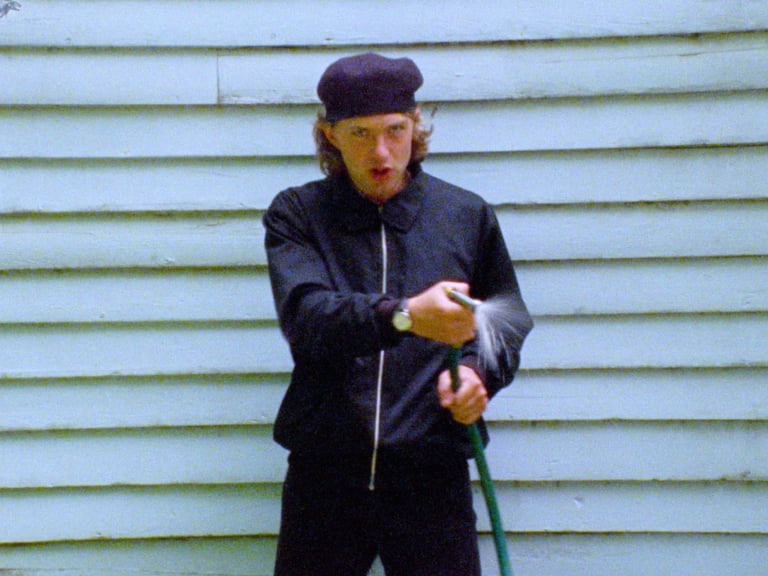
“I was sick of looking at the computer so much,” he says. “This album has a lot of acoustic guitar and upright piano. I still edit some of the things on the computer, but it’s good to have as much of the process outside the screen as possible. That’s what happened with this album: I really zoned into the actual instruments rather than zoning into what to do with a sample, or something like that.”
I wonder, if after all these projects, brings him closer to defining the real essence of what LUCY is? “It’s changing all the time, but it’s not changing so much that it’s something I need to work on finding,” he answers cryptically. “The only thing that doesn’t change is the lyrics. I think the lyrics I have written could be interchangeable with all of my projects. They’re always vague and universal at the same time.”
And it’s this contradiction, ever present at the core of LUCY’s music, which also defines the music he’s drawn to. His Nine Songs choices can be driven by pop and break its logic; they’re uplifting and yet strangely melancholic; strikingly simple with a complex philosophy at their heart. And as he walks me through why he chose them, LUCY realises they hold a mirror up to himself.