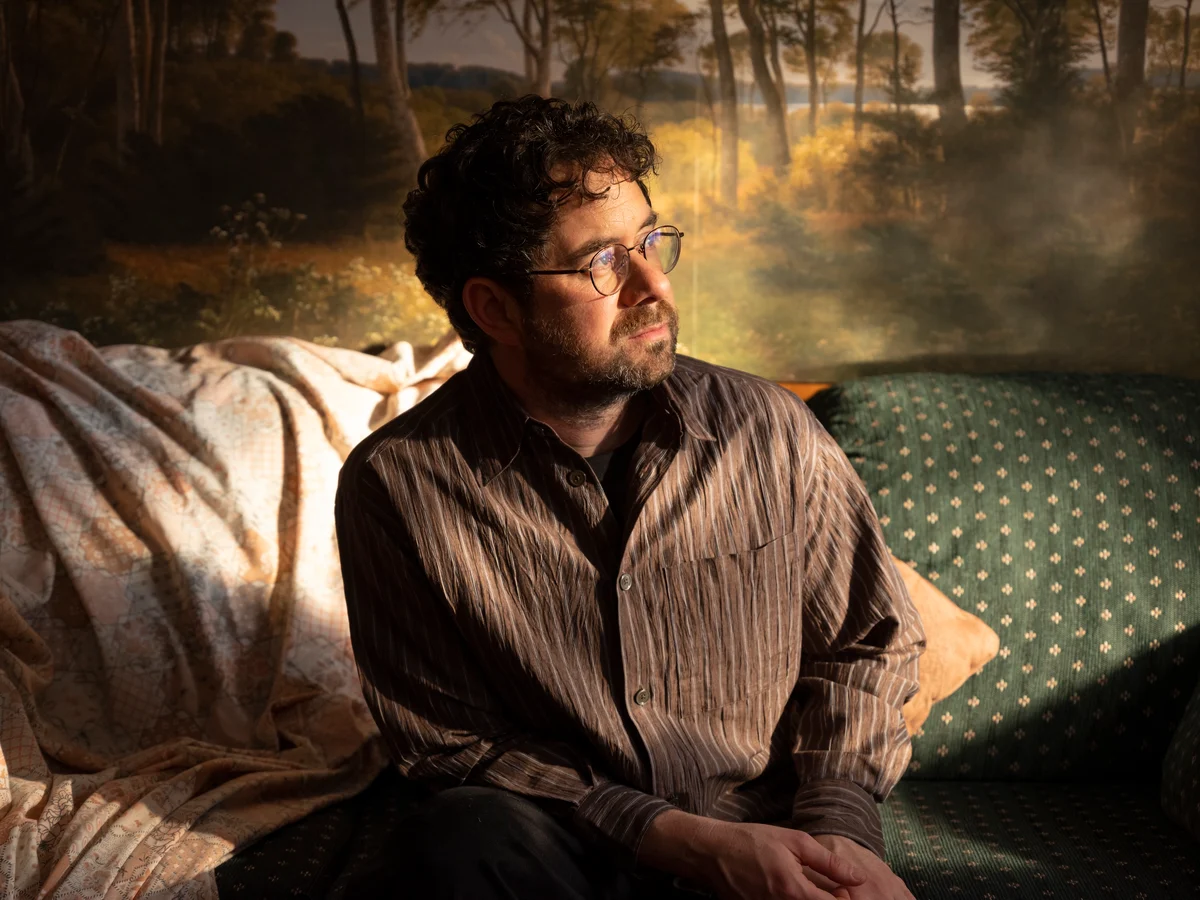
“I don’t have Imposter Syndrome,” he says. “[Classical music] is not my will where I’m from, but I know I belong, and I know I can bring more people with me there. It can really create bridges, and that’s something very important to me.”
The orchestration of turns the page on the collaborative spirit of , his 2024 record with harpist Lara Somogyi, which emerged from three hours of improvisation at her studio in California. An improviser by instinct (“one thing I like the most is just to sit”), was a deliberate undertaking of arranging, recording, and reworking. “There’s certainly something beautiful about working in a group with other humans, especially as a lonely child,” he says. “Because when you’re often alone, when you write down notes or score for other people to play, then you have to think about them, their personality, each instrument, then you have to test it, take notes, ask for feedback – it’s relational.”
For all the album’s expansiveness, however, Blais is less drawn to electronic production than he once was. While ‘ulysse’ sees the 12-strong choir layered and doubled until its voices amount to 48 through overdubbing, Blais has become increasingly wary of electronic sounds dating a record. “There’s something a bit more immortal about acoustic music,” he says, pointing to a solo piano piece from his debut album, , recorded a decade ago, that has recently found its home in a Louis Vuitton advert. An album he made later, with a heavier exploration of electronics, now sounds “very 2018.” Though, he hasn’t abandoned them entirely: sampled organ and fragments of salsa, mambo, and rumba rhythms dapple , but the palpable interaction of working with other musicians is what gives the record its sense of tactility.
With intimate shows scheduled across the globe until October 2027, the album’s arrangements had their maiden voyage in Berlin – where there was no room to bring a piano and ultimately forced Blais and his touring quartet to improvise. Three of the four musicians sing as well as play, dipping between violin, cello, viola, and charango, with voices taking the place of a clarinet, a cello filling in for a French horn. “It was quite a challenge, but I am a very open-minded composer – I always ask everyone’s input, everybody knows better than I – so we managed to do this arrangement that really encapsulates the spirit of the album. It’s been very fluid and surprising. The album has translated magnificently.”
And while ‘muses’ and ‘ulysse’ echo the romance of Odysseus, the process of creation echoed the swaying dips and dives of the Odyssey. was restarted three separate times – even nearly scrapped at one point – due to repeated problems with mixing or timing. Each time, stepping back and adjusting expectations opened up another possibility, and a change of direction eventually took the mixing to the Netherlands, introducing new approaches. “I think every synchronicity comes from the plurality of the obstacles he encountered,” he says. “In trying not to let go every time, but to let go for one day, stop, and try to understand what’s happening and find a solution, it made me a wider and more open person. I’m ready to face more problems.”
The worlds that first opened up in his basement have since become places he’s scrapbooked in his travel diary, languages he has under his belt, and people he’s throwing Christmas parties for; their music, in turn, finding its way into his own compositions. gathers those encounters without trying to replicate them, instead leaving room for each listener to find their own way through it. “The album is not a map of the city where I’m from with each track, the one street name and the store,” he says. “It’s more of a starting point.”