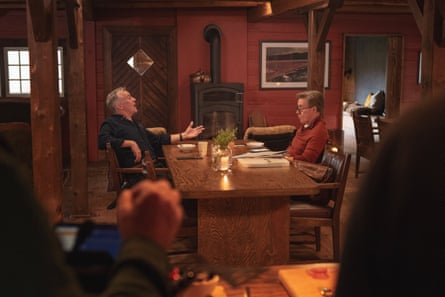
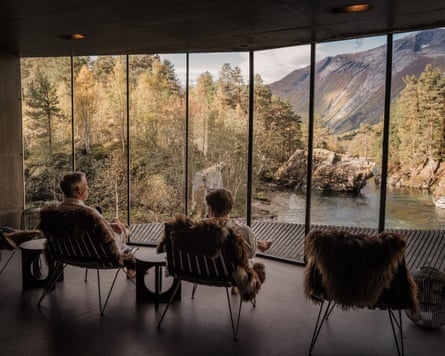
orning in Valldal, and in the pale September light, the Juvet Landskapshotell stands quite still amid mountains, pines and yellowing birch. In the hotel dining room, Steve Coogan and Rob Brydon are taking breakfast; coffee and muesli and compote spread out before them as they settle into a discussion of the playwrights August Strindberg and Henrik Ibsen, and their enduring infatuations with much younger women. "When Ibsen was 60, he fell in love with a teenager called Emilie," Brydon says. "Can you imagine doing that?" Coogan swallows his muesli: "I can imagine it …"
The conversation shifts, taking in the persecuted genius of Galileo, a short exhortation on the subject of Palestine, and how the aurora borealis has just been spotted in the skies above Great Yarmouth. After a time, Brydon falls into an extended impersonation of Melvyn Bragg presenting In Our Time. "Can you expand on that?" he barks at Coogan. "Expand … Expand … Expand." The edges of Coogan's mouth begin to flicker.
The pair are two weeks into filming series five of The Trip, the show devised by director Michael Winterbottom as a kind of blurry version of the actors' real lives. Each season sends them on a kind of Epicurean road trip, under the guise of a journalistic commission; this time, the conceit is that Brydon is making a podcast for the Guardian, and Coogan has agreed to tag along.
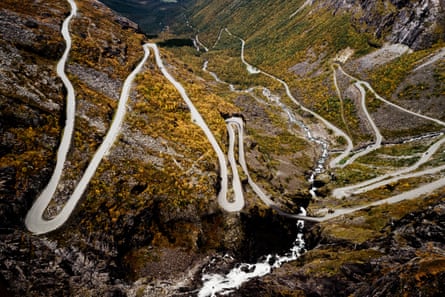
Over the past 16 years, The Trip has taken them from the north of England to a meandering tour of Italy, via Spain and Greece. Now they have reached Scandinavia, heading through Sweden and Norway and up to the Arctic Circle, taking in luxury hotels, fishing huts, brown cheese and reindeer.
It has been six years since they last convened. Since then, much has happened in their lives. Brydon is an established national treasure, hosting gameshows and voicing Julia Donaldson adaptations, even writing a children's book of his own. Coogan has combined a broad populism – revisiting his comic creation Alan Partridge and a turn in The White Lotus, with more nuanced projects – playing Jimmy Savile, for instance, and writing and producing Stephen Frears's film The Lost King.
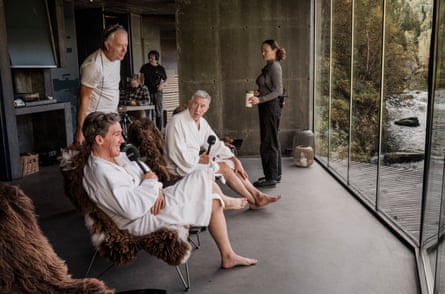
After breakfast, filming moves to the hotel spa, where Coogan and Brydon sit in bathrobes to record a podcast episode, their conversation drifting once again from saunas to birch twigs to an analysis of their own physiques. Meanwhile, the crew fold themselves into tight corners, hover behind camera lines, try not to laugh. All these years in, the show remains joyously funny. Still, in this quiet landscape it is hard not to notice the sense of contemplation that runs through this series; a rumination on age and friendship, pleasure, purpose, isolation and joy.
It is the following summer when we meet again: a wildly hot day in a central London hotel. By this stage, the series is finished, and Coogan has watched three episodes. "I was surprised at how much I laughed," he says. "My memory was that it was just a bit haphazard and a bit silly, but different enough for it to be charming. What I wasn't expecting was to find it so warm and welcoming. Throughout all the cynicism and arguments and spikiness, it has a real humanity."
For a time they sit and discuss the moments that did not make the final cut: James Bond references, digs at other comedians, a plunge into a bracingly cold river. Some established elements of the show remain: there are the famed impressions, jabs about the directions of their respective careers, the appeal of light entertainment, the allure of politics, their differing relationships. But there are shifts in this series, too: subtle turns in subject matter, the old prickliness of their exchanges often giving way to a kind of tenderness.
They are keen, as ever, to differentiate between their onscreen relationship and a real-life friendship that has run for 30 years. These days, Brydon says the pair "get together and talk about middle-aged things". Coogan nods. "We talk about things that are achingly middle-class preoccupations," he says. "Things that are very, very unsympathetic." He reels off a couple of examples: second homes, complaining about staff. "You see, when I was young and from a lower middle-class background, people used to laugh and joke and say: 'Oh, you just can't get the staff …'" he says. "And now I'm 60, and I'm in a different socioeconomic position, I do know what that means."
Brydon looks up. "By the time this comes out, you'll be 61," he says. "It's probably better to say 61. Let's just say you're mid-60s."
Coogan frowns. "No," he says. "Don't say that."
The matter of age runs through The Trip to the northern lights. Today, they talk about the subject with a kind of zeal. "What you notice is that thing of being a bit more carpe diem, a bit more living in the moment," says Coogan. "Just trying to stand outside yourself, and celebrating if things are good."
He noticed this growing feeling in his late 50s, though it only seemed to gather pace as he reached 60, and became a grandfather. "It's a visceral, animal thing," he says. "I've got a granddaughter, and I just want to see her, I just want to be with her, in a way that transcends all of the stuff. I want that almost like a child wants something." He smiles. "Getting old is quite like being a child," he says. "Children live in the moment, and they absorb, and they're quite visceral. And I think when you get older, you start to do that too. I just want to do funny voices. And make her laugh and that's enough."
"What do you do for her, Neil Kinnock?" asks Brydon. "The wheels on the bus go round and round," he sings in a recognisably Kinnockian intonation.
Coogan nods. "Yes," he says. "Just because I know that when she gets older and she starts asking, what does it mean: 'Hiring taxis to scuttle around handing out redundancy notices to its own workers'?"
For Brydon, 61, age has brought a sense of broadening fascination. "I've become interested in other things," he says, "and I love the feeling – and this is going to look awful written down – that I'm ." He speaks of a reverence for nature: birdsong, trees, the feel of his bare feet on the grass. But also for jazz and old cars. "I'm in a very fortunate position," he says, "to have lots of opportunities to experience new things."
"That's the thing," Coogan says. "Because at a certain level, where we are, we are infantilised. And that can be good and bad. The term 'behaving like a child' is double-edged: you can be conceited and selfish, but you can also be curious and open."
"Which of those would you say you are?" Brydon wonders.
"Sometimes I'm spoilt and I feel like things should just be done for me," Coogan says. "But I also feel like I'm still able to have a sense of play. Children, when they're really young, they're not worried if they're cool or not, they just do things." Sometimes, he adds, he looks at politicians young enough to be his own child, and they seem so grown up. "There's no sense of any playfulness or childlike qualities left in them," he says, and sighs heavily.
We meet on the day that Nigel Farage is rumoured to be triggering a byelection in his Clacton seat. "Has he resigned?" Brydon asks. "Let's find out." He slips into the voice of a TV news anchor. "Steve Coogan is in central London. Steve, what's the latest on this?"
Coogan checks his phone. "Latest one hour ago. Oh, seven minutes ago. Oh, oh, oh. He's resigned. He has resigned." He reads Farage's statement aloud. "Now, that's a gamble. A bit like old Burnham's gamble."
"Which position will you be taking up in Andy Burnham's cabinet?" Brydon asks him. In 2025, Coogan was appointed co-chair of the Middleton Mayoral development corporation – a move by Burnham, then still mayor of Greater Manchester, to regenerate the actor's home town. When Burnham duly campaigned for election in the Makerfield byelection, Coogan joined him on the doorstep. "So what would it be, Defence?" Brydon continues, as Coogan explains his role in Middleton. "Secretary of state for defence, Steve Coogan?"
Coogan bats the idea away. "I am very supportive of him," he says. "He's trying to do something really distinctive to get away from Westminster-centric politics. I blame the rise of Reform squarely on what I would call north London intellectual liberals who are part of the cabal of centrist moderation, where they think whether you're left or right is just an intellectual position, like a game of chess."
He leans forward in the overstuffed armchair, gathering speed and intensity. "It's been a game that's been going on for the last 40 years," he says. "And people in the provinces, in post-industrial areas, it means nothing to them and nothing has changed. The only relation to working-class people they have is when the plumber comes round. But they have no real empathy for them. And as long as we have people who seem like they're just a sensible chap, doing a sensible job, Reform will continue to gather momentum because working-class people are fed up, they're lashing out, they want an alternative, and there are no alternatives around. And that is squarely the fault of the Hampstead Pansies." He pauses, breathes. "That's it," he says.
Brydon describes himself as "probably one of those centrists". He is not without passion or belief, but when he speaks about his experience of life it is with more contentment than hunger. "I don't subscribe to more, better, best," he says. "I feel my role in life is to entertain people." He talks of how often people approach him to thank him for his work – in Gavin & Stacey, say, or hosting Would I Lie to You? "And I'm very happy with that. I'm happy doing it. And I feel that that is what I put into the world. I try and do good. But I'm not an activist. I'm just not that person."
It is interesting, then, to think of the young Brydon. The son of a car salesman and a teacher, he grew up in Baglan, near Port Talbot, coming of age at the height of Thatcherism, and just as the nearby steelworks was forced to lay off half its workers. There was certainly something in him that did not want to stick around; like Coogan, he applied, unsuccessfully, to Rada. Surely that shows a dream of something more or better?
"Yes," he concedes, "in those days, of course. But success came to me later. Steve was successful in his 20s. I was 34, 35, and I had been around the block. I'd had limited success in Wales as a radio and TV personality. And by the time I met Steve, I was making a nice living – ski holidays, two cars, all that stuff – because I was a voice artist. But then it came. So I think I've always appreciated it more. I already had three children so I'd matured to a certain degree."
"The thing Rob has done, what's not often addressed, is he could have gone down the route of just being a lightweight, fringe act – someone who gets by with getting the stuff that more successful people reject," Coogan says. "Mopping stuff up, making a living, just getting by by being affable. But, no." There was a period, he points out, where Brydon was writing and starring in the devastatingly dark comedies Human Remains and Marion & Geoff, and simultaneously making appearances on the Home Shopping network. "The thing I've always said to Rob is, he's a brilliant character actor, but he's sort of …" he tries to find the most diplomatic way to put it, "… he's not that, but he's …"
"Well, I did a bit," says Brydon. "But when you talk about being content and everything, what no one ever mentions is my five children. When people talk about people's careers, it's as if they're existing in a vacuum. And for me, the choices that I make are because I don't want to go away. For the last 30 years I've had children growing up and the need and the want to be around. So that has been a big part of my career."
By contrast, Coogan has one daughter, who is now 30. It has been a long time since he was bound by the restrictions of childcare and school holidays. "I do feel like I'm a bit like I'm 24 and have no responsibilities," he says. "I've got a partner, but she has a career, she has another life."
The divergent paths of their careers is sometimes puzzling to Coogan. He is confused by Brydon's willingness to be a personality, his ease at being recognised. "You're so accessible and approachable, they feel like they know you," he says. Once, the pair walked together up a mountain, and as other walkers approached, Coogan found himself looking away for fear of being recognised. "But he would be face-forward, open and friendly. I would want to avoid that like the plague." It is easier, sometimes, for him to play a role; Partridge, for example, or even the augmented version of himself we see in The Trip. "Basically, because I don't feel entirely comfortable in my own skin," he says.
"That's the difference," Brydon interjects. "I do."
Accordingly, Brydon is quite happy with the span of his career – one week hosting ITV gameshow The Floor, the next playing Peter O'Toole in a Radio 4 drama, followed by "a big animated film" and a new sitcom, Bills Included, for Coogan co-founded production company, Baby Cow. He is never quite sure where the road will take him.
"But the joke I always say is that 'Steve is driven. I like to be driven. In an S-Class Mercedes or equivalent.'" Coogan laughs. "It was you who said to specify that," Brydon tells him.
"Well I don't like people carriers," Coogan says affably. "The Mercedes – which I wouldn't drive, but I'd quite like to be a passenger in – is because you can make the rear seat recline. And that's very important because I like to nap. Now that might sound like I'm a prima donna, but I do like to nap, because I'm 60."
They joke for a moment about how they are ageing "properly"; a careful balance of somnolence and wonder. I think back to one night in Norway, when Brydon had headed off to bed, and a member of staff rushed in and urged us all to hurry outside. In the cold night air we gathered in the courtyard and looked up. There, high above the silent rooftops, the northern lights undulated across the sky: pale green and pink and golden. I remember how we stood there, quite rapt. And how I looked across at Coogan, and saw his face, lit up like a child. There in the moment, enjoying everything.
The Trip to the Northern Lights starts Thurs 10 December on Sky Atlantic & Now.