hen did you last attend an orchestral concert in which the composers' average age hovered around 30? Classical music loves prodigies, but these days they tend to be performers rather than composers. The high-stakes game of orchestral programming favours the experienced, not to mention the deceased. So how invigorating to encounter an entire concert that oozed youthful confidence, creative energy and moments of explosive swagger.
The opener was These Premises Are Alarmed, the miniature with maximalist ambitions composed for the Hallé's inauguration of the Bridgewater Hall in 1996 by the then 25-year-old Thomas Adès. Noisy and knowing, it barrels out of rattles and twitches to stretch briefly into a bold lyrical sweep before fragmenting into high shrieks and slabs of low brass. The Hallé's performance was electrifying: every phrase held taut, every sharp edge made to matter.
Although Adès and the orchestra go way back, this was his first outing as the Hallé's new principal guest conductor. In his own Asyla (premiered when he was 26), Adès marshalled his extravagant forces – bass oboe, 10 double basses, contrabass bassoon etc – through geological rumbles, raucous angularity and cool slow-motion. The orchestra was instantly responsive to Adès's gestures, the details crystalline even in the wildest moments.
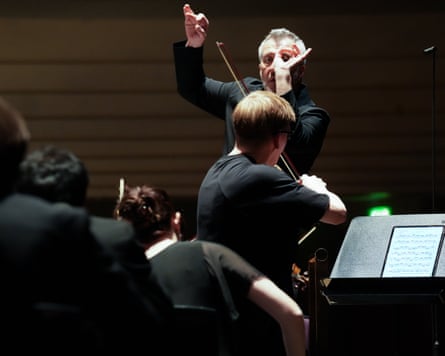
The world premiere of the Violin Concerto: How to Be a Bird by Gabriella Smith (34) featuring Pekka Kuusisto was a forensic study of colourful orchestral textures, characterised by almost ubiquitous tremolo and trilling. Kuusisto's lines – often silvered by harmonics or creaking under bow pressure – were woven through the orchestral fabric, just occasionally breaking into figuration that might have been lifted from Bach or Vivaldi. Odd moments of tonal blandness stood out amid so much urgent exploration, but as Kuusisto trilled into the stratosphere, absolute silence fell.
Most thrilling, though, was Stravinsky's Firebird Suite (revised when the composer was 36). Some passages were achingly elegant; others gleefully unbuttoned; many were fast. At times, Adès seemed to hold his baton in two hands to slice as if playing in Wimbledon. The result was a winning, fierce performance that sounded utterly fresh.