But reviews of Hail to the Thief at the time were tepid. NME noted that the album “was good, rather than great”, observed how the band’s “famed gloominess is becoming self-parodic”; while NME, incredibly, noted that ‘There, There’ was “truly underwhelming”. Generally, the mood was indifferent, with each critic longing for an ear-pleasing rock follow-up to and OK, Computer.
With time, Hail to the Thief has emerged as a cult classic, owing to its timeless and rare accomplishment of soundtracking unease, distrust and disillusion – exactly what Jones had felt in 2003. She’d been working on set design for a staging of and was struck by the similarity between the album that chronicled her present-day and a play written 400 years prior: “Both look at the complexity of what it is to be human, to delude yourself and be deluded by your government. To find your moral compass in the world,” she says in the programme’s notes.
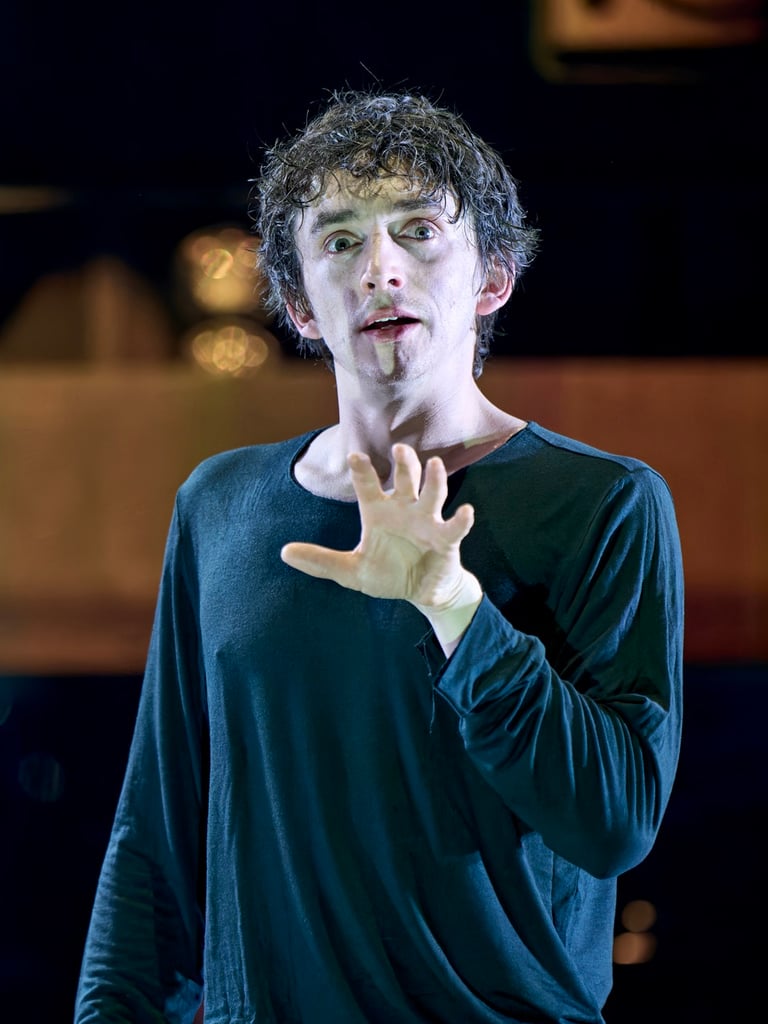
Fast forward some twenty years when Jones was finally able to bring these worlds together in Hamlet Hail to the Thief, working alongside Thom Yorke and co-creator Steven Hoggett to do so. Hamlet Hail to the Thief premiered at Manchester’s Aviva Studios (Factory International) in 2025, followed by a run at the Royal Shakespeare Company in Stratford-upon-Avon, and now landing at The Barbican. In each iteration, the play has proved to be an outstanding success. Jones had probably not intended to wait over twenty years to act upon her intrigue between Shakespeare and Radiohead, but the timing of this play has come at a moment of perfect resonance.
As Ann Thompson and Neil Taylor note in the 2006 Arden Shakespeare edition of Shakespeare’s Danish play has “always resonated with those living under oppressive regimes” – citing instances of staged versions across the Soviet Union that frames Hamlet as an “intellectual dissident in a totalitarian state”. Today’s mood, while markedly different, carries a similar sense of resignation and rage – we’ve lost control against the tech race and have allowed our society to become fully dependent on entities we no longer control. We’re all accidents waiting to happen.
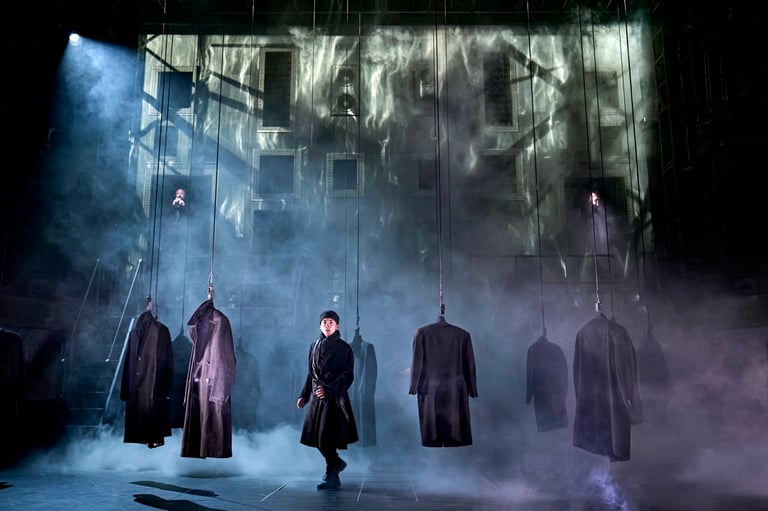
Much like the frustrated prince, we find ourselves in a world where the crime has already been done. The King is dead, and we’re up against invisible, faceless forces that have committed the murder. The suspicion, the paranoia, the claustrophobia of Elsinore is embedded in our pockets, a virtual prison of which we’re unable to escape.
Yorke’s participation in this production is also commendable. At a time when veteran musicians like Benny Andersson revisit their back catalogue through faceless, high-tech cashcows like and AI-powered albums, the fact that Yorke has bet on something as analogue and ancient as a play – with a band, a cast of human actors, and audiences that can only see in a space – is an example of exactly the role art should be serving us today. An antidote, a refuge. A reminder that we can still find each other and talk freely, experience originality, express ourselves using our bodies and our words, our phones switched off and our minds astute.