hy is James Bond not a TV series by now? Harry Potter, Lord of the Rings, Alien, Star Wars – all given the TV treatment. Franchise-mining is fantastic business, maximising attention share in order to sell adverts. So why not Bond, which is co-owned by Amazon? Maybe watching a punchy sex addict every week, saying his name with weirdly administrative syntax, might just be … too much?
I entertained these thoughts while struggling to get through another series expansion: Blade Runner 2099 (Prime Video, from Wednesday). I'm a fan of the films. Before the original, cinema had imagined the future as serene and orderly. Blade Runner introduced many of us to novelist Philip K Dick's vision, in which tech has colonised every aspect of life, but inequality has got worse. Surveillance, artificial beings and unchecked corporate power hollow out whatever remains of society. (The fact the new series is on Amazon is the closest it gets to making a joke.)
As an aside, any title that ends with a "99" risks sounding like a price point, before you factor in the Jeff Bezos of it all. It's easy to imagine this show interrupted by a jarring, algorithmic voiceover: "The Blade Runner, £20.99, cuts linoleum and vinyl flooring to size, and even cork panels!" Prime Video already offer clickable adverts during streaming, so such cross-promotional revenue streams must be something they've considered.
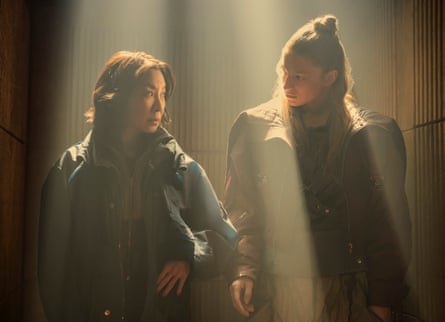
Anyway, the premise is solid. Set 50 years after Denis Villeneuve's Blade Runner sequel, the series imagines a flipped social order. After ecological catastrophe on Earth, artificial humans have risen up and taken over. Blade runners are now a task force of replicants who hunt rebellious humans. One such human, Cora, infiltrates the LAPD to track down a mysterious item that will expose a huge secret. She's partnered with a dying blade runner, who's tracking down a missing officer, who is also looking for … something. The fact is, halfway through the series, I don't know what's going on.
To give the creators their due, they haven't made concessions for TV. I was worried they might stray too far from the tone of the films but they haven't. If filming science fiction is like arranging an orgy, in that it all depends on establishing an atmosphere, then they have succeeded wildly. There is atmosphere to burn.
The signature 80s, eerie synthscape of the original remains. In fact, it runs through every scene. When planes of alienated noise aren't slicing across dialogue, there's a bowel-quivering bass rumble that may well have hindered my houseplants' growth cycle. When that drops out, it's replaced by religious-inflected vocalisations or random mechanical clanking. The sound of this show alone could nullify your SSRIs, before you grapple with its themes of grief, isolation and robot apocalypse.
The visuals are starkly industrial, amber-saturated or filled with plumes of smoke. It's impressive but oppressive, too. Starting each new episode feels like clocking on to a shift at an underground sulphur mine. Time moves slowly. The camera isn't in a hurry, and neither are the actors. Their spare dialogue is delivered with portentous pauses between lines, as if the existential weight of dystopia has given everyone chronic fatigue. Or they know they have a lot of time to fill. They're also standing in the dark, a lot. Grimness: too much. Comprehension: too little. Laptop speakers: stuffed.
For me, intensely atmospheric pieces like this work better in a cinema set-up and at film length. For example, I loved Blade Runner 2049's sweeping canvas, which it owed to Roger Deakins. It ended in snow-blank, abstracted shots that paralleled its themes of birth and moral choice. It stuck the landing. Blade Runner 2099 plunges us into a far darker world, and after four hours I still don't know why.
Perhaps odd for a TV critic to say, but not everything should be TV. Hunter Schafer, who plays Cora, and Michelle Yeoh, who plays the dying blade runner, are possibly doing great work. I don't know. If you're a cyberpunk who mainlines ennui and likes watching actors you can't see, speaking words you can't hear, this show may well knock your fishnet socks off. But why spend this much time immersed in a doomed world, when you could open up a window and watch the real one? It's live!